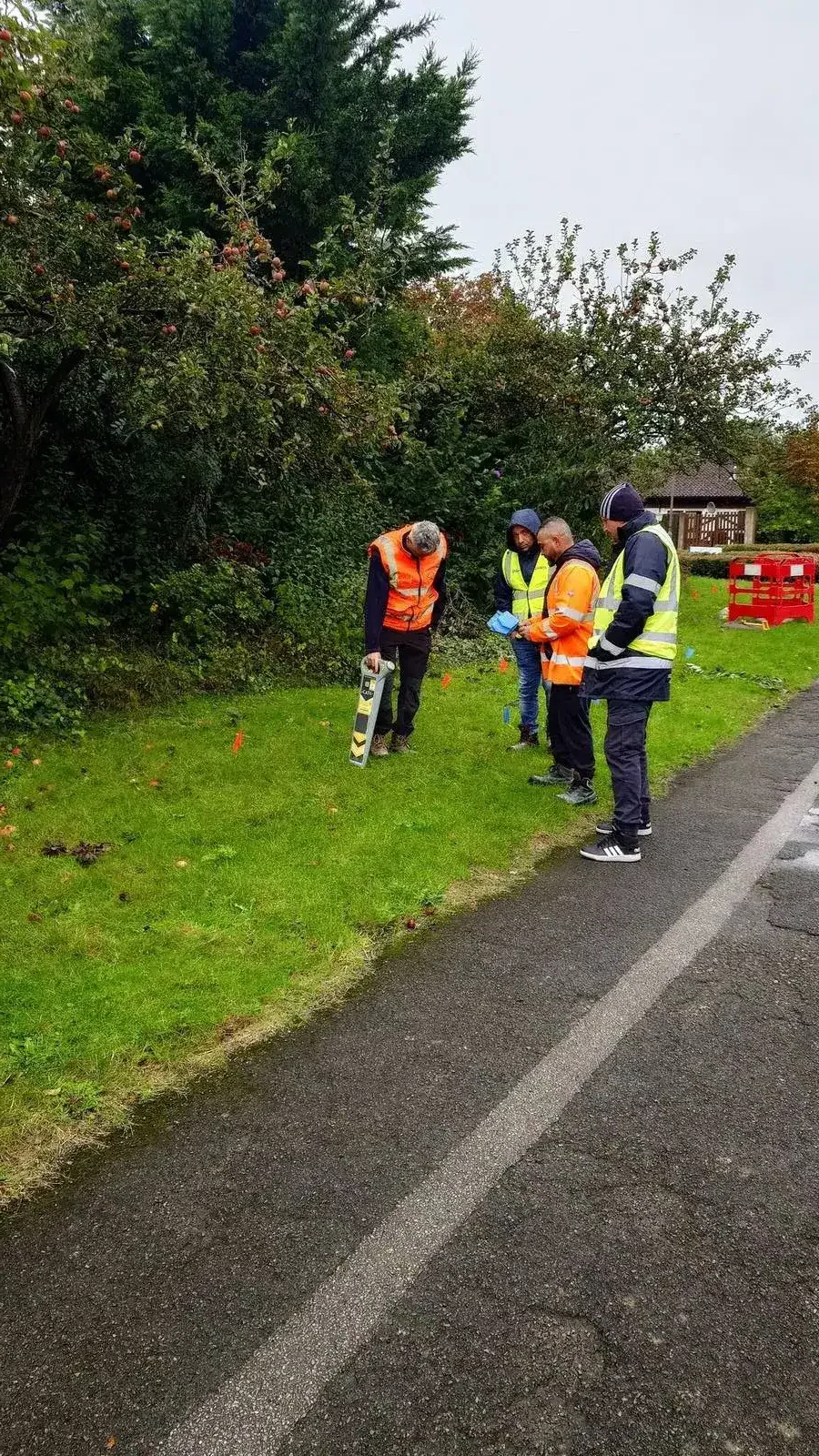
Utility Avoidance
ProQual CAT1 Plus: The Most Advanced Utility Locating Qualification Available
Two days. Forty-two individually assessed practical criteria. Seven advanced theory papers. Two qualifications. Built for operatives who need to locate in the conditions that basic training does not prepare them for.
Duration
2 Days
Qualifications
CAT1 + CAT1 Plus
Theory
Written papers (not MCQ)
Practical
42 assessed criteria
Assessment
Every criterion individually assessed
Who Is This Course For
Designed For
Operatives Locating on Live Sites
Anyone who uses a CAT and Genny to locate underground services before or during excavation. This course takes them from foundation to advanced in one programme.
Lead Locators and Surveyors
Professionals who need to demonstrate mastery of capacitance, signal clamp, dual frequency and advanced transmitter techniques on congested or deep-service sites.
Organisations Requiring ProQual Accreditation
Companies whose procurement framework or competency standards mandate ProQual-accredited qualifications for utility avoidance.
Teams New to ProQual
The 2-day programme is the most efficient route. Delegates complete both ProQual CAT1 and ProQual CAT1 Plus in a single booking, leaving with two qualifications.
About This Course
Beyond the Basics
Most cable avoidance courses teach operatives how to use a CAT and Genny in standard conditions. That is not enough. Signal loss. Problem cables. Street light services. Capacitance on non-earthed conductors. HV cable limitations. Depth readings that cannot be trusted. These are the situations that cause strikes, and they are the situations that standard training does not cover.
ProQual CAT1 Plus is a 2-day programme that covers everything. The first day delivers the full ProQual CAT1 specification, including written theory papers and eight individually assessed practical criteria covering all four locating modes: Power, Radio, Genny and Avoidance. The second day adds seven advanced theory criteria and over thirty additional practical criteria that go far beyond what any other qualification on the market assesses.
Delegates leave with two qualifications: ProQual CAT1 and ProQual CAT1 Plus. Both are independently assessed by Sygma assessors and certificated through ProQual Accreditations. Every criterion must be met individually. There is no percentage pass mark and no multiple choice questions.
Sygma delivers this course with the methodology that defines all its training: Genny-First. Every practical session requires delegates to exhaust all transmitter connection opportunities before moving to induction, and to exhaust all active modes before passive. This is the correct approach for reducing strikes, and the Plus criteria (PP3.3) specifically test whether operatives have internalised it.
The Only Qualification We Do Not Have to Add To
In 21 years of delivering utility avoidance training, Sygma has had to add content to every qualification on the market to make it fit for the real demands of the industry. Every single one. The ProQual CAT1 and CAT1 Plus qualifications are the first we have developed in partnership with an awarding body that cover everything needed from a course in this subject. They are the only qualifications we deliver where we do not have to supplement the syllabus, because the syllabus was built to the standard the industry actually needs.
Already Hold ProQual CAT1?
If your team already holds a current ProQual CAT1, you can book the 1-day Plus add-on instead of the full 2-day programme. The add-on covers the seven additional theory criteria and thirty-two additional practical criteria. Contact us and we will confirm whether the 1-day option is suitable.
Quick Reference
Course at a Glance
| Qualifications Awarded | ProQual CAT1 Locate Utility Services + ProQual CAT1 Plus (both certificated by ProQual Accreditations) |
| Duration | 2 days (full programme) or 1 day (Plus add-on for existing CAT1 holders) |
| Prerequisites | None for the 2-day programme. The 1-day add-on requires current ProQual CAT1. |
| Theory Assessment | Written theory papers (CAT1: T1-T7) plus Theory Plus papers (TP1-TP7). Not multiple choice. |
| Practical Assessment | 42 individually assessed hands-on criteria: 8 under CAT1, 34 under CAT1 Plus (PP1-PP4) |
| Advanced Techniques | Capacitance (high-frequency signal), signal clamp, dual-frequency transmitter, blind induction sweep, nulling, airborne signal checks, depth quality verification using two independent methods |
| Delivery | Sygma HQ (Wigan), The Survey School (Worcester), or on-site at your premises anywhere in the UK |
| Equipment | Sygma provides Radiodetection CAT4 and Genny4 as standard. Skills are transferable to any electromagnetic locator. For client-supplied alternative equipment: minimum one locator per three delegates. |
| Upgrade Path | ProQual Level 3 Certificate in Site Surveys, Advanced EM Locator (Level 4), or Level 5 Diploma in Utility Surveying |
| Pricing | Contact for pricing |
| CITB Funding | Sygma is a CITB ATO. Speak to your Employer Network adviser about funding. |
Theory Assessment
Knowledge Criteria
The written theory assessment covers fourteen criteria areas across two papers. The standard CAT1 paper (T1-T7) covers foundation knowledge. The Theory Plus paper (TP1-TP7) covers the advanced knowledge required for demanding site conditions. All theory is assessed in writing, not multiple choice.
CAT1 Theory (T1-T7)
The foundation theory paper covers locator and signal generator operation, pre-use checks, the four locating modes (Power, Radio, Genny, Avoidance), service identification, safe systems of work, CDM Regulations, risk assessment, and HSG47/GS6 guidance. These criteria establish the knowledge base that the Plus criteria build on.
Theory Plus (TP1-TP7)
| Ref | Criterion |
|---|---|
| TP1 | Pre-survey: understand the differences between PAS128 surveys and Utility STATS plans |
| TP2 | Pre-use equipment checks: understand limitations of electromagnetic locators (what they can and cannot detect), plan the survey using signal generator and locator based on the site, function check, in-service date check (calibration), understand a permit to dig |
| TP3 | Transmitter applications: use correct search technique at correct distance from induced signal, dual and multi-frequency transmitter operation and benefits, frequency options when using induction, limitations of induction as a non-selective method, exhausting all transmitter applications before passive modes |
| TP4 | Locating, pinpointing and tracing: causes of sudden signal loss, obtain depth estimates at correct distances from transmitter in connection, clamp and induction, recognise when depth is unreliable, check depth reading quality by two methods |
| TP5 | General: HV cable location limitations, dual and multi-frequency transmitter benefits, induction frequency options, induction limitations (non-selective), blind induction sweep, continuous scanning as excavation progresses, services that a locator with signal generator will not detect |
| TP6 | Health, safety and environment: responsibilities under HASAWA, HSG47 and GS6 guidance, PPE requirements, site-specific risk assessments and control measures for utility locating activities |
| TP7 | Locating and detecting services: interpreting utility drawings and line search documents, typical depths of underground services, marking methods, hazards associated with different services and damage response, roles and responsibilities, visual locating methods, principles of electronic locating equipment (direct connection, induction, nulling out, Power and Radio modes), signal generator attachments, interpreting results, external influences on readings, reporting deviations |
Practical Assessment
42 Hands-On Practical Criteria
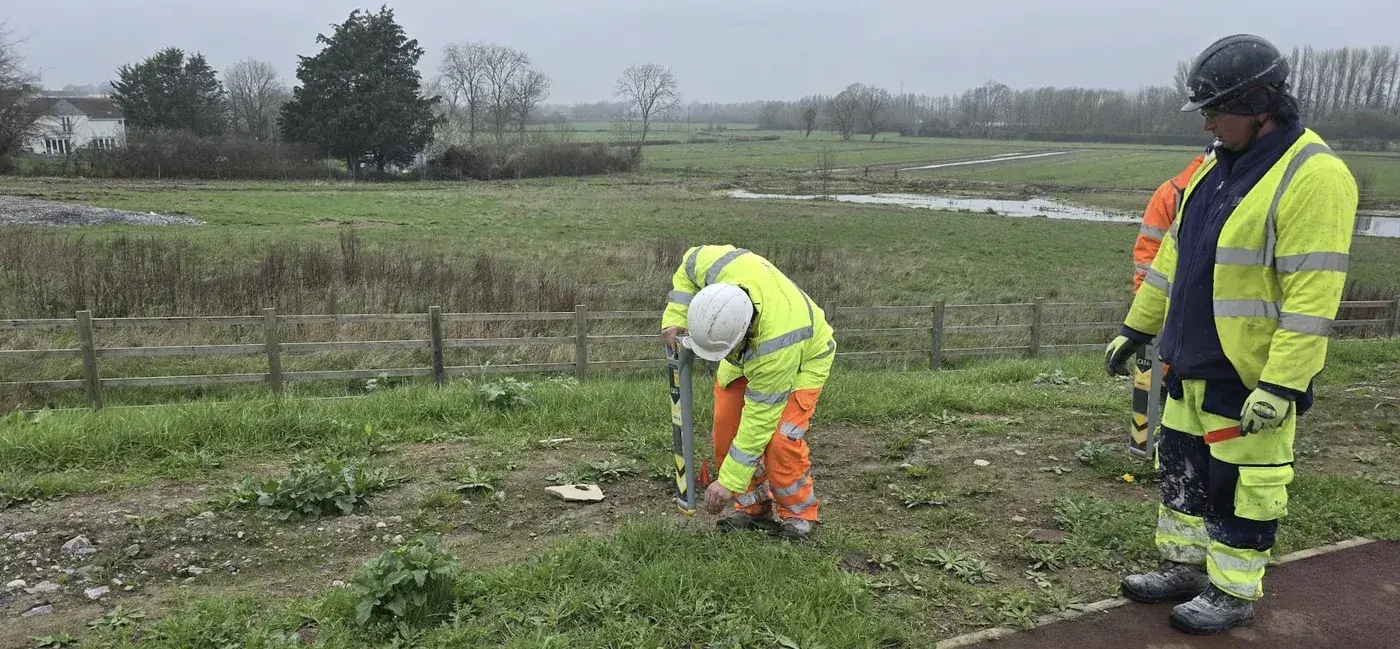
The practical assessment is conducted on a live training rig with buried services. All criteria must be demonstrated to the assessor's satisfaction. The standard CAT1 practical (P1-P8) is assessed on the first day. The advanced Plus practical criteria (PP1-PP4, 34 individual items) are assessed on the second day.
The CAT1 practical covers: visual survey, pre-use equipment checks, direct connection, locating in all four modes (Power, Radio, Genny, Avoidance), sensitivity control, depth estimation, marking position, and Genny-First methodology.
Plus Practical Criteria (PP1-PP4)
PP1: Pre-Survey and Transmitter Applications (17 criteria)
- ›Read utility plans from all providers including keys and symbols (PP1.1)
- ›Complete a visual survey in conjunction with plans, identifying visual indications of services (PP1.2)
- ›Pre-use equipment checks including function check and in-service date check/calibration (PP1.3)
- ›Direct connection to a known utility; earth transmitter in correct position; check signal applied (PP1.4-PP1.6)
- ›Apply signal to street light cable via direct connection (PP1.7)
- ›Use correct search technique at correct distance from direct connection point (PP1.8)
- ›Apply signal to domestic LV service at a property or building (PP1.9)
- ›Apply high-frequency signal using capacitance technique (PP1.10)
- ›Apply signal using signal clamp with correct search technique at correct distance (PP1.11-PP1.12)
- ›Apply induced signal to known target with correct search technique (PP1.13-PP1.14)
- ›Perform blind induction sweep in two directions across a site (PP1.15)
- ›Null out a buried utility (PP1.16)
- ›Check for airborne signal in all inductive applications (PP1.17)
PP2: Locating, Pinpointing and Tracing (12 criteria)
- ›Control sensitivity/gain to locate and pinpoint utility (PP2.1)
- ›Correctly determine direction of utility (PP2.2)
- ›Trace utility using correct technique and mark position (PP2.3)
- ›Identify sudden signal loss (PP2.4)
- ›Locate a joint, T-connection or bend (PP2.5)
- ›Know when locator is too close to transmitter (PP2.6)
- ›Understand issues with excessive signal and erratic sensitivity, and how to correct (PP2.7)
- ›Obtain depth estimates at correct distances from transmitter in connection, clamp and induction (PP2.8)
- ›Check depth reading quality by two methods (PP2.9)
- ›Peak and Null identification (PP2.10), Sonde location (PP2.11, optional), GPR awareness (PP2.12, optional)
PP3: Strategic Survey Methodology (3 criteria)
- ›Use utility plans to apply transmitter signal in most suitable place throughout survey (PP3.1)
- ›Use plans to correctly apply induced signal in best place to locate HV cables (PP3.2)
- ›Conduct survey using transmitter first, exhaust all transmitter connection opportunities before moving to induction (PP3.3)
PP4: Passive Modes (2 criteria)
- ›Perform Power survey using appropriate sensitivity control and correct search technique (PP4.1)
- ›Perform Radio survey using appropriate sensitivity control and correct search technique (PP4.2)
What You Get
At the End of This Course
Two ProQual Qualifications
ProQual CAT1 Locate Utility Services and ProQual CAT1 Plus, both certificated through ProQual Accreditations
Written Theory Evidence
Assessed theory papers covering 14 criteria areas, demonstrating knowledge in the candidate's own words rather than through multiple choice
42 Practical Criteria Assessed
Documented evidence of competence across every individually assessed hands-on criterion, from direct connection through to advanced survey methodology
Personalised Training Record
Detailed breakdown of all theory and practical criteria with assessor commentary and ongoing access to Sygma trainers for post-course questions
Not All CAT1 Courses Are Created Equal
ProQual CAT1 Plus vs EUS CAT1: Why These Are Not Equivalent
The ProQual CAT1 Plus goes far beyond what the EUS CAT1 assesses. Where EUS covers a topic through multiple choice questions only, we have marked it as not covered, because an MCQ does not demonstrate that a candidate can apply that knowledge in practice.
| Assessment Area | ProQual CAT1 Plus | EUS CAT1 |
|---|---|---|
| CDM Regulations | Theory assessment (CAT1 base) | Not covered |
| Risk assessment monitoring and reporting | Theory assessment (CAT1 base) | Not covered |
| SSOW aligned with HASAWA, HSG47 and GS6 | Practical assessment (CAT1 base) | Not covered |
| PAS128 vs Utility STATS plans | Theory Plus assessment (TP1) | Not covered |
| Electromagnetic locator limitations | Theory Plus assessment (TP2) | Not covered |
| Depth reading quality verification (two methods) | Theory + practical (TP4, PP2.9) | Not covered |
| HV cable location limitations | Theory Plus assessment (TP5) | Not covered |
| Blind induction sweep | Theory + practical (TP5, PP1.15) | Not covered |
| Continuous scanning during excavation | Theory Plus assessment (TP5) | Not covered |
| Capacitance technique (high-frequency signal) | Practical assessment (PP1.10) | Not covered |
| Signal clamp application | Practical assessment (PP1.11-PP1.12) | Not covered |
| Street light cable location via direct connection | Practical assessment (PP1.7) | Not covered |
| Domestic LV service location | Practical assessment (PP1.9) | Not covered |
| Signal loss identification | Theory + practical (TP4, PP2.4) | Not covered |
| Joint, T-connection and bend location | Practical assessment (PP2.5) | Not covered |
| HASAWA 1974 responsibilities | Theory assessment (CAT1 + TP6) | MCQ only (insufficient) |
| HSG47 and GS6 provisions | Theory assessment (CAT1 + TP6) | MCQ only (insufficient) |
| Specific locator features (shallow alert, Avoidance, depth, calibration) | Theory + practical (CAT1 base) | MCQ only (insufficient) |
| Data-enabled locators | Theory + practical (CAT1 base) | MCQ only (insufficient) |
| Pass standard | Every criterion must be met individually | 80% MCQ + practical sign-off |
| Knowledge assessment method | Written theory papers (CAT1 + Plus) | Multiple choice questions |
| Total practical criteria assessed | 8 (CAT1) + 34 (Plus) = 42 | Practical sign-off only |
| External verification | ProQual Accreditations auditor | None |
| EUSR registration | No | Yes |
Not sure which qualification your organisation needs? Contact us and we will check your procurement framework for you.
Why Choose Us
Why Sygma for ProQual CAT1 Plus
Sygma helped write the ProQual CAT1 Plus specification. We do not just deliver this course. We helped define what it should be.
Specification-Aligned
Genny-First in the Assessment Criteria
ProQual CAT1 Plus specification (PP3.3) requires candidates to conduct a survey using the transmitter first and exhaust all transmitter connection opportunities before moving to induction. This is the Genny-First methodology formalised into independently assessed qualification criteria. No other awarding body has embedded this principle.
Industry Leadership
We Helped Write This Standard
Sygma was directly involved in developing the ProQual CAT1 and CAT1 Plus specifications. These are the only utility avoidance qualifications we do not have to supplement, because the syllabus was built to the standard the industry actually needs.
Two Qualifications
Complete Programme in 2 Days
Delegates leave with both ProQual CAT1 and ProQual CAT1 Plus. No need for separate bookings, separate travel, or separate assessment days. One programme, two qualifications, forty-two practical criteria assessed.
Expert Delivery
Specialist Trainers
Every trainer directly employed. All ex-utility surveyors or ex-equipment manufacturer specialists. All TAQA qualified. Nobody teaches this subject who has not done the job.
Objectivity
Fully Independent
No surveys, no equipment sales, no manufacturer relationships. We teach one subject and we teach it without bias. Every piece of advice is based on what works, not what we sell.
Convenience
We Come to You
Delivered at your site anywhere in the UK. All equipment, training rigs and materials included. No hidden extras.
Proven Results
70-80% Increase in Genny Usage
Clients who implement our Genny-First methodology report a 70 to 80% measurable increase in signal generator usage. Measured through locator data downloads, not surveys.
Regulatory Framework
HSG47 Compliance
HSG47 requires that anyone using a cable locator must be trained and competent. ProQual CAT1 Plus exceeds this requirement with the most comprehensive practical assessment available. The course covers safe systems of work, service plan interpretation, correct use of equipment in all modes, and continuous scanning during excavation.
The ProQual certification provides auditable proof of competency that satisfies HSG47, GS6 and CDM requirements.
Funding
CITB Employer Network
Sygma is a CITB Approved Training Organisation. All Sygma courses exceed 51% practical content, meeting CITB standards for hands-on training delivery.
Speak to your CITB Employer Network adviser about funding for the ProQual CAT1 Plus programme.
FAQs
Frequently Asked Questions
What qualifications do delegates receive at the end of the 2-day course?
Both. Delegates who complete the full 2-day programme receive ProQual CAT1 and ProQual CAT1 Plus as separate qualifications. The CAT1 criteria are assessed on the first day and the advanced Plus criteria on the second. Both certificates are issued through ProQual Accreditations.
Can I attend the Plus day only if I already hold ProQual CAT1?
Yes. If your team already holds current ProQual CAT1, you can book the 1-day Plus add-on instead of the full 2-day programme. The add-on covers the seven additional theory criteria and thirty-two additional practical criteria that the standard CAT1 does not include. Contact us and we will confirm whether your existing CAT1 is current and whether the 1-day option is suitable.
What is the difference between ProQual CAT1 Plus and EUS CAT1?
They are fundamentally different qualifications. ProQual CAT1 Plus builds on an already more rigorous CAT1 base and adds seven theory criteria and over thirty practical criteria that EUS does not cover at all. Topics like PAS128 vs Utility STATS plans, capacitance technique, signal clamp, depth quality verification, HV cable limitations, blind induction sweeps, and signal loss identification are all assessed in ProQual CAT1 Plus but absent from EUS entirely. Where EUS relies on multiple choice questions, ProQual uses written theory papers and individually assessed hands-on practical criteria. In 21 years, Sygma has had to add content to every qualification on the market to make it fit for industry. The ProQual CAT1 and CAT1 Plus are the only qualifications we do not have to add anything to, because they cover everything needed.
How many individual practical criteria are assessed across the 2 days?
The full 2-day programme assesses 8 practical criteria under the CAT1 standard and a further 34 individual practical criteria under the Plus standard, giving a total of 42 hands-on practical demonstrations. Each one is observed and assessed individually by a Sygma assessor. This is not a paper-based assessment.
What is the difference between capacitance and induction?
Both methods use the signal transmitter to apply a signal without direct connection to the service. Induction broadcasts a signal across a wide area and is non-selective. Capacitance uses a high-frequency signal applied directly above the service to specifically target it, making it more effective for non-earthed conductors. ProQual CAT1 Plus covers both and requires delegates to demonstrate when and why to use each.
Do I need to bring my own CAT and Genny?
No. Sygma provides Radiodetection CAT4 and Genny4 units as standard. The skills taught are transferable to any electromagnetic locator. If you want training delivered on your own equipment, we can accommodate that. We require a minimum of one locator per three delegates for client-supplied equipment.
Is CITB funding available for this course?
Sygma is a CITB Approved Training Organisation. Speak to your CITB Employer Network adviser about funding. All Sygma courses exceed 51% practical content, meeting CITB standards for hands-on training delivery.
Training Path
Related Courses
Build your team's cable avoidance skills across our suite of ProQual-accredited qualifications.
ProQual CAT1
One-day qualification for operatives who need independently assessed cable avoidance competence. The standard CAT1 is included in the 2-day Plus programme.
ProQual CAT2
Safe excavation qualification. If your team locates and digs, they need both. Can be combined with CAT1 Plus for a comprehensive programme.
Level 3 Certificate
ProQual Level 3 Certificate in Site Surveys. The next step for lead locators who want to progress beyond CAT1 Plus.
Book ProQual CAT1 Plus Training
Available at Wigan, Worcester, or on your site anywhere in the UK. Two days, two qualifications, forty-two practical criteria assessed.